01
Friction & skin folds
Skin tags are common in areas of repeated skin-to-skin or clothing friction.
Small skin growths are common, but not every growth is a skin tag. Understanding what you are seeing is the first step before considering removal.
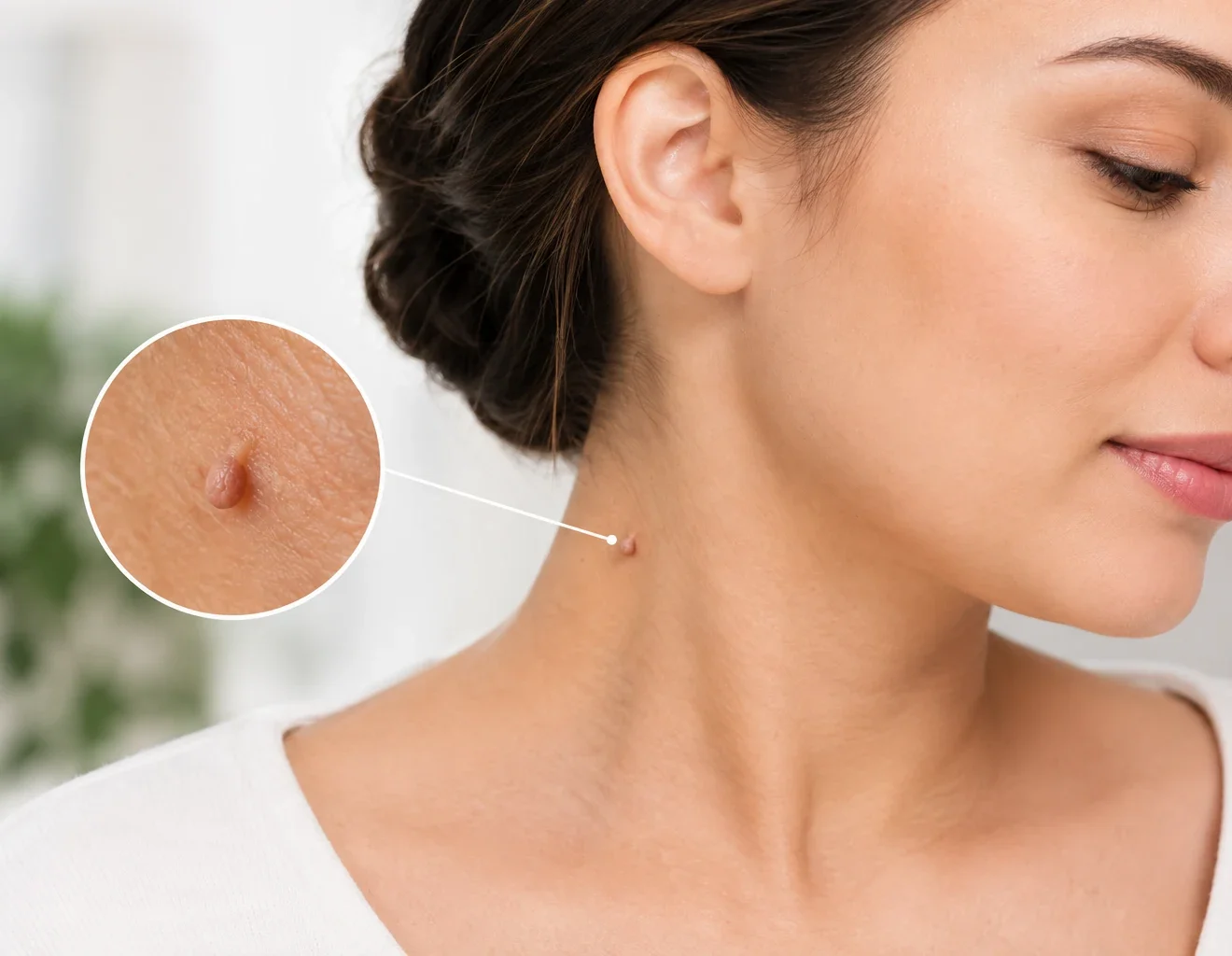
Skin tags are usually harmless. However, moles, warts and other skin lesions can sometimes look similar. A medical examination helps confirm the diagnosis before removal.
A skin tag, medically called an acrochordon, is a small, soft, benign growth of skin and connective tissue. It is often attached to the skin by a narrow stalk.
Skin tags may be skin-coloured or slightly darker. They are commonly seen on the neck, underarms, eyelids, groin and other areas where skin rubs against skin or clothing.
They are not contagious and usually do not require treatment unless they become irritated, catch on clothing or cause a cosmetic concern.
Appearance alone cannot confirm a diagnosis.
There is no single established cause. Several factors are associated with their development.
Skin tags are common in areas of repeated skin-to-skin or clothing friction.
Genetics, age and pregnancy may influence the likelihood of developing skin tags.
Skin tags are more common with obesity and insulin resistance, but do not establish a medical diagnosis by themselves.
A lesion that changes quickly, bleeds unexpectedly, becomes painful or looks different from your other skin growths deserves medical evaluation.
If the diagnosis is uncertain, the doctor may recommend further assessment rather than immediate cosmetic removal.
Many benign skin conditions can resemble one another. A doctor considers the lesion's appearance, location, history and any recent changes before deciding whether removal is appropriate.
Removal is not always necessary. If a skin tag is asymptomatic and its appearance is typical, leaving it alone may be a reasonable choice.
When removal is appropriate, the technique is selected according to the lesion's characteristics and location.
Controlled heat is used to treat the skin tag. The procedure may involve local anaesthesia depending on the lesion and treatment area.
Selected laser techniques can be used to remove suitable skin tags. The choice depends on medical assessment; laser is not necessarily preferable for every lesion.
A small treated area may form a superficial crust before healing. Healing time varies by lesion size, treatment method and individual skin response.
Temporary darkening or lightening of the skin, infection and scarring are possible complications.
Clear answers to common questions about diagnosis, removal and recovery.
Skin tags are benign growths and are usually harmless. A growth that changes appearance, bleeds without an obvious reason, or looks unusual should be assessed by a doctor.
A completely removed skin tag usually does not return at the same site. However, new skin tags can develop in other areas.
The degree of discomfort depends on the size, location and removal method. Local anaesthesia may be used when appropriate.
Small treated areas often heal within one to three weeks. Healing varies with the size and site of the lesion, the method used and individual factors.
Skin tags are more common in people with insulin resistance and certain metabolic conditions, but their presence alone does not diagnose diabetes.
Home cutting, tying or chemical removal can cause bleeding, burns, infection and scarring. A skin growth should be identified before any removal is attempted.
A small scar or temporary lightening or darkening of the skin is possible. The risk varies by technique, skin type, treatment area and healing response.
The cost depends on the number, size and location of the lesions and the method selected after medical assessment. Please contact Medrose for current pricing.
A consultation can help identify the lesion and determine whether removal is appropriate.
Contact Medrose on WhatsApp ↗