1960

The first working laser
Physicist Theodore Maiman demonstrated the first functioning laser on 16 May 1960, using a synthetic ruby crystal.
From the first laser in 1960 to today’s advanced dermatological applications, controlled light has become an important tool in modern medicine. At Medrose Medical Center, laser treatments are part of evidence-based, personalised treatment plans.
Explore Our Laser Services →
Physicist Theodore Maiman demonstrated the first functioning laser on 16 May 1960, using a synthetic ruby crystal.

Dr. Leon Goldman published pioneering research demonstrating how laser light interacts with pigmented skin structures.

Rox Anderson and John Parrish published the principle explaining how carefully selected laser pulses can target particular structures in tissue.

Laser technology now includes a range of wavelengths and techniques for hair reduction, pigmentation, tattoo removal, acne scars and other dermatological indications.

A medical laser is a sophisticated device designed to deliver controlled energy to specific structures in the skin.
Its performance depends not only on the technology itself, but also on the condition of the equipment, regular technical checks and servicing, appropriate maintenance and the knowledge of the person operating it.
The appropriate wavelength, pulse characteristics and energy delivery for the intended treatment.
Regular technical checks and servicing to support reliable and consistent performance.
Appropriate patient selection, treatment parameters, eye protection and clinical assessment.
Laser light is a concentrated form of light with specific physical properties. Different wavelengths are absorbed by different chromophores in the skin, such as melanin (in hair and pigmentation), haemoglobin (in blood vessels) and tattoo pigments.
The appropriate laser is not simply the most powerful one. It depends on the intended target, skin characteristics, treatment area and clinical indication.
Learn More About Laser Science →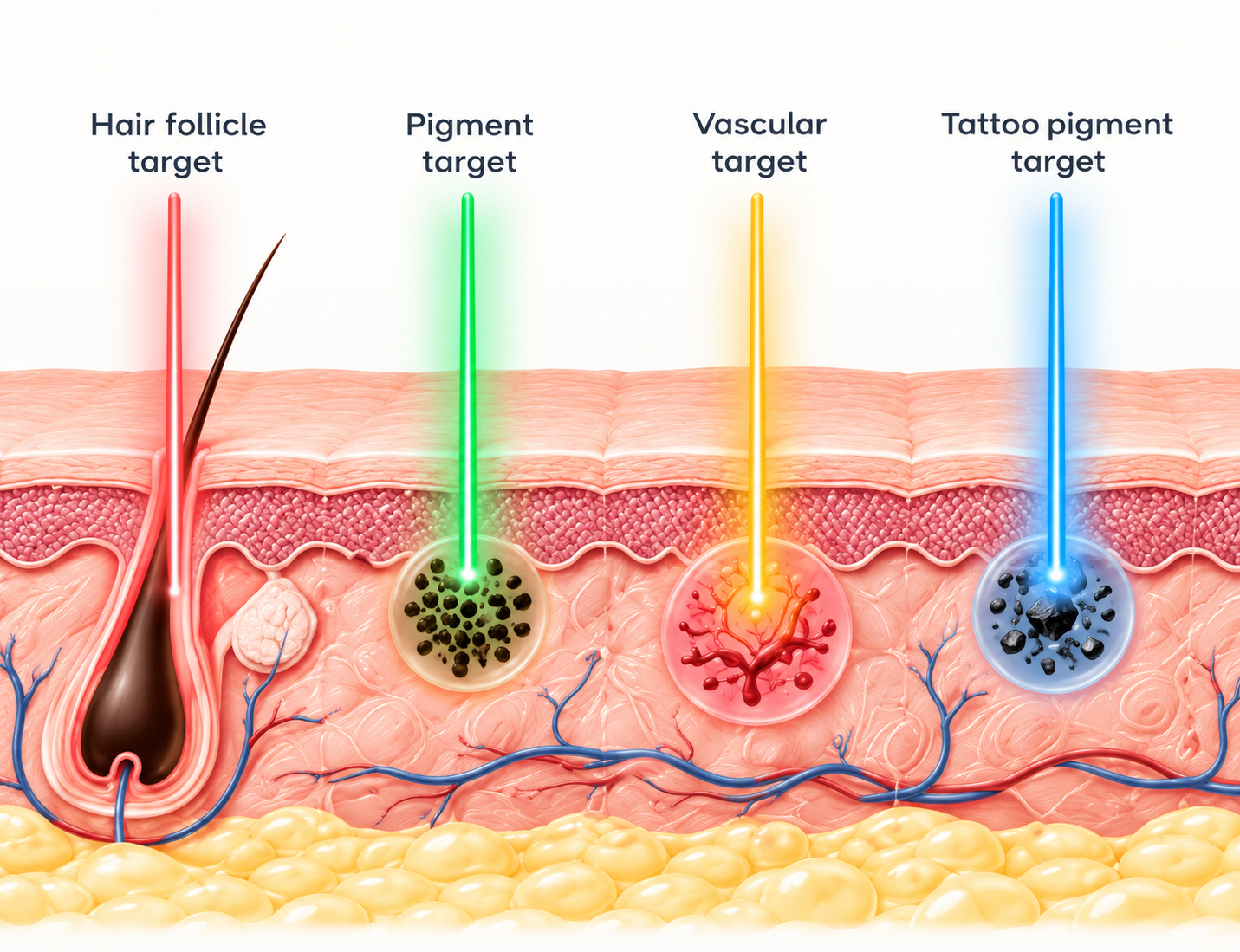
How Alexandrite and Nd:YAG wavelengths can target pigmented hair follicles, with treatment selection according to skin and hair characteristics.
Learn more →Laser treatment can target visible blood vessels on the legs and other areas, helping to reduce their appearance.
Learn more →How short laser pulses interact with tattoo pigment, and why ink colour, depth and composition influence treatment.
Learn more →An introduction to laser-induced lightening of fine facial hair, including its limitations and the postshine risk of paradoxical hair growth.
Understanding laser technology and its selected applications to help improve large pores, acne scars and overall skin rejuvenation.
Learn more →Laser treatments can target different types of pigmentation, such as sun spots, melasma and post-inflammatory hyperpigmentation, depending on the skin characteristics and clinical assessment.
Learn more →At Medrose Medical Center, laser treatment begins with understanding the skin and the purpose of treatment. Different wavelengths and techniques have different indications, benefits and limitations. A thorough clinical assessment helps determine whether a laser procedure is appropriate, and when another approach may be preferable.
Book a Consultation →