01
Significant Tooth Damage
A crown may be recommended when a tooth has extensive structural damage and requires more coverage than a conventional filling can provide.
Medrose Medical Center | Barsha Heights, Tecom

Restorative Dentistry
Dental crowns and bridges are restorative options used to restore damaged teeth or replace missing teeth, helping to restore function, tooth structure and appearance where clinically appropriate.
Restorative Dental Care
Dental crowns and bridges are restorative dental options that may be recommended when a tooth is damaged or one or more teeth are missing. The choice of restoration depends on the condition of the teeth, the surrounding structures and your individual dental needs.
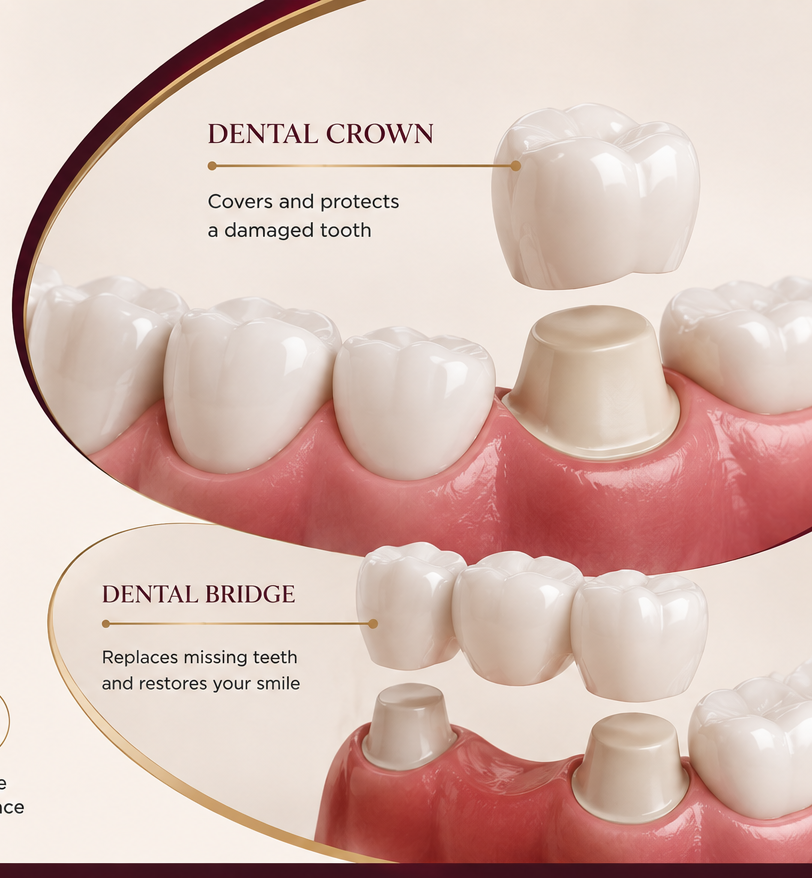
A crown covers a tooth to help restore its shape, strength and function. A bridge may be used to replace one or more missing teeth by supporting an artificial tooth with adjacent teeth or other suitable supporting structures.
Your dentist will assess your oral health and explain whether a crown, bridge or another restorative option may be appropriate for your situation.
When Treatment May Be Considered
A crown or bridge may be considered when a tooth needs additional support or when missing teeth affect chewing, bite function or the appearance of your smile. Your dentist will determine the most suitable approach after examining your teeth and gums.
A crown may be recommended when a tooth has extensive structural damage and requires more coverage than a conventional filling can provide.
A bridge may be considered to replace missing teeth when the supporting teeth and oral conditions are suitable.
Some teeth treated with root canal therapy may need a crown for additional protection, depending on the amount of remaining tooth structure.
A crown or bridge may be considered when a restoration is needed to support appropriate chewing function and tooth structure.
Your Dental Appointment
Treatment planning depends on the type of restoration required and your oral health. Your dentist will explain the process, discuss the available options and answer your questions before proceeding.
Your dentist examines the affected teeth, gums and bite. Dental X-rays or other investigations may be recommended when clinically indicated.
If treatment is suitable, the tooth or supporting teeth may be prepared according to the planned restoration and clinical requirements.
An impression or digital scan may be taken to help design a restoration that fits the prepared area and works with your bite.
The restoration is checked for fit, comfort and bite. Adjustments may be made where needed before it is secured according to the treatment plan.
Understanding Your Options
Crowns and bridges serve different purposes. The recommendation depends on whether the main concern is a damaged tooth or a gap left by missing teeth.
A crown covers an existing tooth to help restore its shape, strength and function when additional protection is needed.
A bridge replaces one or more missing teeth by using supporting teeth or other suitable supporting structures.
Care & Maintenance
The lifespan of a crown or bridge varies between individuals. It depends on the restoration, oral hygiene, bite forces and the health of the supporting teeth and gums. Regular dental reviews can help identify concerns that may affect the restoration.
The material selected, restoration design and suitability for the tooth can influence durability and function.
Brushing, cleaning between teeth and attending dental reviews help maintain the health of the restoration and surrounding tissues.
Grinding, clenching, bite forces and the condition of supporting teeth may affect how the restoration performs over time.
Contact your dentist if a crown or bridge becomes loose, feels uncomfortable, chips or causes pain. Do not attempt to repair a damaged restoration yourself.
Crowns and bridges are not suitable for every dental condition. Your dentist will assess the affected teeth, gum health, bite and supporting structures before recommending treatment. Alternative options may be discussed where appropriate.
Common Questions
Find answers to common questions about dental crowns and bridges.
The timeline depends on the type of restoration, the condition of your teeth and whether additional treatment is needed. Your dentist can explain the expected steps and timing after assessment.
Local anaesthesia is commonly used during tooth preparation when needed for comfort. Your dentist will explain the approach based on the procedure and your individual needs.
Your dentist will provide instructions based on the type of restoration and whether a temporary or final restoration has been placed. You may be advised to avoid hard or sticky foods in certain circumstances.
Their lifespan varies according to the material, oral hygiene, bite forces and the health of the supporting teeth and gums. Regular dental check-ups help monitor their condition.
Possible concerns may include sensitivity, discomfort, damage to the restoration, changes in fit or problems affecting supporting teeth and gums. Your dentist will discuss relevant risks based on your clinical assessment.
A crown or bridge may be replaced if it becomes damaged, worn, loose or no longer suitable. Replacement depends on the condition of the restoration and the supporting teeth and gums.
Book a dental assessment at Medrose Medical Center in Dubai to determine whether a crown or bridge is suitable for you.
Book a Dental AssessmentTreatment recommendations are based on individual clinical assessment. Restorative treatment requirements and outcomes vary between patients.